Service Dog Tasks and the Public Access Test, Explained
This page explains the law in general terms. It is not legal advice. For a specific situation, contact the agency listed on this site or an attorney.
People often ask what tasks a service dog can do, and whether a dog has to pass a public access test before it can go out in public. The two questions are linked, but the answers are different. Tasks decide whether a dog is a service dog at all. The public access test is a training benchmark, not a legal requirement.
This guide walks through how to identify a task, train it with rewards, and use the public access test as a way to measure your progress. It is written for Missouri handlers, so it also covers the state definition and the rules on misrepresenting a dog.
What counts as a service dog task
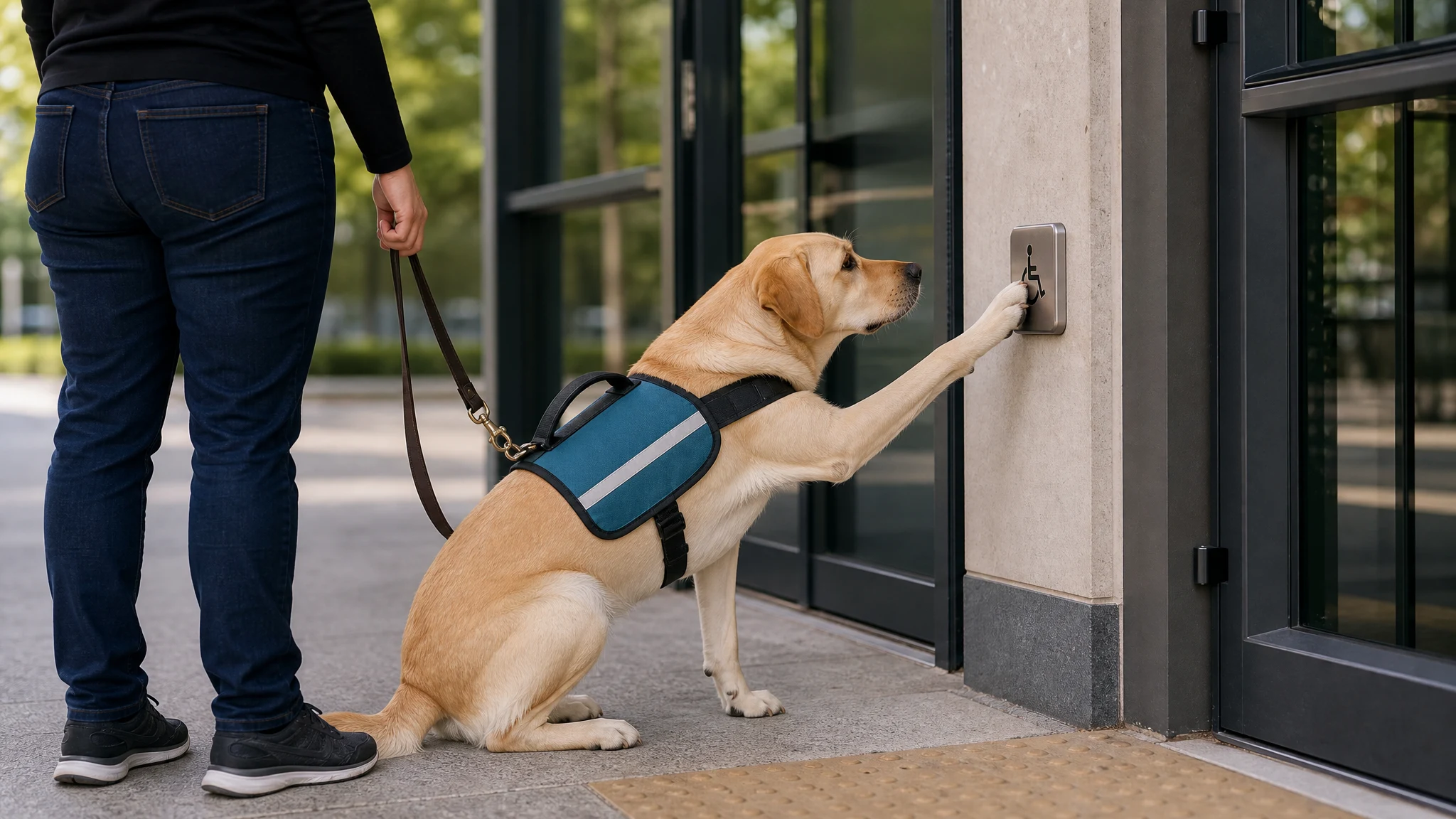
The ADA.gov Service Animals FAQ says a service animal is a dog individually trained to do work or perform tasks for an individual with a disability. The key word is trained. A task is a specific action the dog has learned to do, and it has to relate directly to the person's disability.
Missouri uses a similar definition. The Missouri Revisor of Statutes, RSMo 209.200, defines a service dog as a dog being or having been individually trained to do work or perform tasks for a person with a disability. The statute lists physical, sensory, psychiatric, intellectual and other mental disabilities. It names guide, hearing, medical alert or response, mental health or psychiatric service, mobility, professional therapy, and search and rescue dogs. The same section says it does not go beyond the ADA.
Examples of tasks by disability
The lists below show the kinds of tasks handlers and programs commonly train. They are examples, not a complete or official list. Each dog's tasks should match its handler's actual needs.
| Type of disability | Example tasks |
|---|---|
| Mobility or physical | Retrieving dropped items, opening or closing doors, pulling a manual wheelchair, bracing for balance, turning light switches on or off |
| Hearing | Alerting the handler to a doorbell, smoke alarm or a person calling their name |
| Vision | Guiding around obstacles, stopping at curbs and stairs |
| Medical (for example seizure or blood sugar conditions) | Alerting to a change, fetching medication or a phone, getting help |
| Psychiatric, including PTSD | Interrupting repetitive or self-harming behavior, checking a room, waking the handler from nightmares, creating space in a crowd |
| Autism or other cognitive disability | Preventing a handler from bolting into traffic, interrupting a harmful pattern, helping find the handler's way to a safe place |
Missouri's definition names mental health or psychiatric service dogs, so psychiatric tasks fall within the state's wording. The same test applies as for any other task: the dog does something it was trained to do, and it relates to the disability.
Why comfort alone is not a task
A dog's calming presence can matter a great deal to a person. Under the ADA, though, emotional support, therapy and comfort animals are not service animals. Being there, offering affection or lowering stress by simply existing is not trained work.
The line is whether the dog does something specific on cue or in response to a sign. Pressing its body on a handler's chest during a panic episode, after being trained to do that when it detects the signs, can be a task. A dog that simply feels soothing to be near is providing comfort. Both are valuable. Only the first meets the ADA definition.
Materials you will need
- A written list of your disability-related needs, kept for your own planning
- A flat buckle collar or a well-fitted harness (no prong, choke or shock collars)
- A standard leash of about six feet
- Small, soft treats your dog finds exciting, plus a few higher-value ones for hard moments
- A treat pouch and, if your dog responds well to it, a clicker or a marker word
- A training log or notebook to track each session
- A mat or bed for settling practice
- Access to a variety of places to practice, starting quiet and getting busier
Step-by-step: train a task, then work toward the public access test
Step 1: Name the task and what it does for you
Write one sentence for each task: "When X happens, my dog does Y, which helps me by Z." If you cannot say how it helps with your disability, it may be comfort rather than a task. That is a useful check before you invest weeks of training.
Under the ADA.gov Service Animals 2010 Requirements, staff at a business may ask two questions: whether the dog is a service animal required because of a disability, and what work or task the dog has been trained to perform. A clear one-sentence answer makes those moments easier.
Step 2: Build the foundation first
Before tasks, your dog needs steady basics: sit, down, stay, come when called, loose-leash walking, and a settle on a mat. Teach each with rewards. Mark the behavior you want the instant it happens, then reward. Keep sessions short, a few minutes each, and stop while your dog is still keen.
Methods should follow the humane, reward-based approach recommended by the American Veterinary Society of Animal Behavior (AVSAB). Avoid corrections that rely on pain, fear or intimidation. They can damage trust and make a working dog less reliable.
Step 3: Break the task into small pieces
Trainers call this shaping or chaining. Say your goal is for the dog to retrieve a dropped set of keys. Reward looking at the keys, then touching them, then picking them up, then holding, then bringing them to you, then placing them in your hand. Add one piece at a time. Move on only when the current piece is easy.
Step 4: Add a cue or a trigger
Some tasks are done on a cue you give, such as a word or a hand signal. Others are done in response to a trigger, such as a sound or a change in your behavior. Practice the cue or trigger on its own, reward the right response, and slowly make the setup more realistic.
Step 5: Practice in more places
Dogs do not automatically carry a skill from the living room to the grocery store. Repeat each task in a new room, then the yard, then a quiet street, then a busy one. Lower your expectations in each new place and use better treats. This is called generalizing, and it is the step most often skipped.
Step 6: Teach public manners
A service dog out in public should be under control and calm. Build these skills on top of the tasks:
- Walking beside you on a loose leash past people, food and other dogs
- Ignoring dropped food and strangers who try to pet or call to the dog
- Settling under a table or chair and staying there
- Waiting at doors and entering and exiting calmly
- Staying relaxed in elevators, store aisles and around carts
- Resting quietly without barking or whining
Step 7: Use the public access test as a benchmark
The public access test is a standard that Assistance Dogs International (ADI) uses to assess whether an assistance dog and handler team behaves reliably in public. Many accredited programs use it to decide when a team is ready. Check with ADI or your program for the current version and scoring, since this article does not reproduce them.
The test usually looks at things like control, calm behavior around distractions, handling skills and the dog's reaction to ordinary public settings. You can borrow that approach even if you train on your own: write a list of public situations, run through them with a helper, and score yourself honestly.
The test is a benchmark. It is not a license, and passing it does not create legal status. The ADA does not require a service dog to pass a public access test, and it has no official certification or registry. A Missouri handler who has not taken the test is not breaking the ADA for that reason.
What matters legally is that the dog is individually trained to do work or tasks and is under the handler's control. A dog that disrupts a business, or is out of control, can be asked to leave under ADA rules. Using the test as a yardstick helps you avoid that.
Step 8: Keep a record and keep training
Log each session: what you practiced, where, how long, and how your dog did. A record helps you spot weak areas and shows how consistent your training has been. Keep refreshing skills. Working dogs can slip when practice stops.
What the law in Missouri says about access and training
The Missouri Revisor of Statutes, RSMo 209.150, says persons with disabilities have equal rights to public places and full and equal access to transportation carriers, lodging and public accommodations. They may bring a specially trained service dog without extra charge. They are liable for any damage the dog does to premises or facilities.
For dogs still in training, RSMo 209.152 covers a trainer from a recognized training center for guide, hearing assistance or service dogs, and any member of a service dog team. They may be accompanied by the dog in training at the places listed in RSMo 209.150, without extra charge, and are liable for damage the dog causes. The section does not go beyond the ADA. For details such as age, harness or identification conditions, check the statute text or ask the Missouri agency listed below.
For a fuller overview of rights, training and where dogs can go, see our guide to service dogs in Missouri: training, access rights and where they can go.
Do not misrepresent a dog
Under RSMo 209.204, it is a class C misdemeanor, plus civil liability for actual damages, to knowingly misrepresent a dog as a service dog. The statute lists using false documents, putting a vest or harness on a non-service dog, and claiming training that has not been completed. A second or later violation is a class B misdemeanor. Subsection 3 applies the same penalties to misrepresenting an animal as an assistance animal for Fair Housing Act or Rehabilitation Act accommodation.
No official registry or certificate exists under the ADA, and the Missouri Governor's Council on Disability service animals page describes no state ID program. Online registration or ID products are not legal proof of anything. Do not rely on them.
Tips and common mistakes to avoid
- Confusing comfort with a task. If the dog's only job is to be near you, it does not meet the ADA definition. Train at least one specific action tied to your disability.
- Rushing into public. Moving too fast to crowded places can teach a dog to fail. Raise difficulty in small steps.
- Using pain-based tools. Shock, prong and choke collars, alpha rolls, scruffing and dominance methods are not part of humane training. They are not consistent with AVSAB guidance.
- Skipping rest and play. A dog that works constantly may burn out. Build in downtime.
- Treating the test as a pass or fail verdict on the law. It measures readiness. It does not decide your rights.
- Training only in easy places. If your dog is perfect at home and distracted in stores, go back a step.
- Ignoring the dog's stress signals. Yawning, lip licking, turning away and freezing can signal that the dog needs a break or an easier setting.
- Not asking for help. A qualified, reward-based trainer can spot problems you may miss.
Expected results
With steady, reward-based practice, many teams see a dog gradually become more reliable at its tasks and calmer in public. Progress varies a great deal by dog, handler, disability and the complexity of the task. Some tasks may take weeks and others many months. Training does not guarantee that a dog will qualify as a working service dog, and not every dog is suited to the work.
A realistic goal is steady improvement: fewer reminders, quicker responses and more comfort in busy settings. If your dog finds the work stressful, talking with a qualified trainer or a program about other options is a reasonable next step.
Where to find help in Missouri
You may train a dog yourself or work with a program. These Missouri organizations are named in the sources below. Check each one directly for eligibility, costs and waitlists, since those details are not confirmed here.
- CHAMP Assistance Dogs, Inc in St. Louis, listed as ADI accredited
- Duo Dogs, Inc. (formerly Support Dogs, Inc.) in St. Louis, listed as ADI accredited
- Retrieving Freedom, Inc. in Sedalia, listed as ADI accredited
- Missouri Patriot Paws in Rolla, which says it serves veterans and first responders with PTSD or TBI free of charge and relies on donations
- Heartland K9s for Veterans in Neosho, which says it gifts service dogs to veterans at zero cost
Veterans can also look at the Missouri Veterans Commission's service and support animals resource list, which names several providers.
If you believe your rights were denied
This article states the law and is not legal advice. Missouri's Commission on Human Rights, part of the Department of Labor and Industrial Relations, handles discrimination complaints. Its page does not mention service animals specifically, so ask the agency whether your situation fits. You can reach it at 573-751-3325 or toll-free at 1-877-781-4236. The address is 421 E. Dunklin, P.O. Box 1129, Jefferson City, MO 65102-1129. For federal questions, start with the ADA.gov Service Animals FAQ.
Sources
- ADA.gov Service Animals FAQ
- ADA.gov Service Animals 2010 Requirements
- Missouri Revisor of Statutes, RSMo 209.150
- Missouri Revisor of Statutes, RSMo 209.152
- Missouri Revisor of Statutes, RSMo 209.200
- Missouri Revisor of Statutes, RSMo 209.204
- Missouri Governor's Council on Disability, Service Animals
- Missouri Commission on Human Rights
- Assistance Dogs International member search